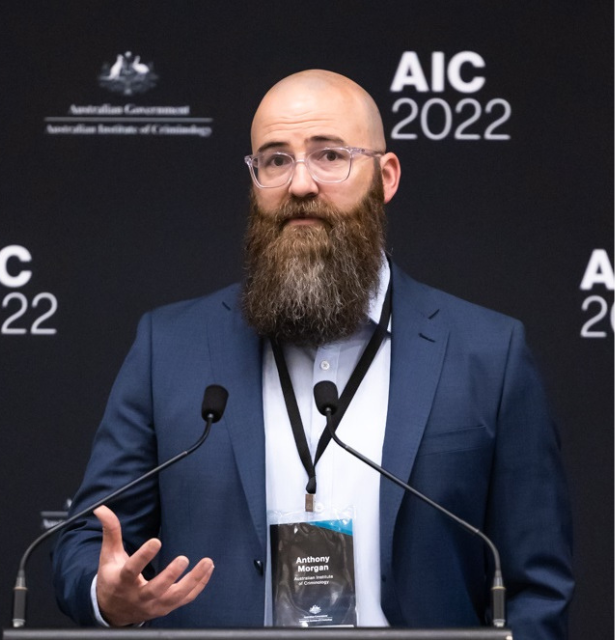
 is the Research Manager for the Australian Institute of Criminology’s Serious and Organised Crime, Cybercrime and Radicalisation Research Program. Committed to promoting evidence-based policing, Anthony has spent nearly two decades working closely with law enforcement and policy makers to conduct rigorous, applied and policy relevant empirical criminological research. He developed the Serious and Organised Crime Research Laboratory to be a leading centre in Australian applied organised crime research with partnerships with law enforcement and world-leading academics, a national and international footprint, and several Australian-first studies. More recently his research has focused on the online environment, overseeing the development of the Australian Cybercrime Survey and Survey of Social and Political Beliefs in Australia and leading research into cybercrime victimisation and factors that influence people’s vulnerability to radicalisation.
Presentations
Participation in anti-authority protests, vulnerability to radicalisation and implications for protest policing
Mr Anthony Morgan, Dr Tim Cubitt, Ms Isabella Voce
1Australian Institute Of Criminology, Canberra City, Australia
In recent years there has been an increase in anti-authority protest involving individuals and groups driven by a range of motives and ideologies. Some of these protests have posed a genuine threat to community safety and resulted in violent clashes with law enforcement. Following a request from the Five Eyes Law Enforcement Group, we undertook research to help better understand the threat posed by anti-authority protests and implications for the policing of these protests. Using data from a large, national survey of online Australians, we found that anti-authority protesters exhibited more risk factors and fewer protective factors for cognitive and behavioural radicalisation than other respondents, including people who had participated in protests in support of other issues or movements. They were also more likely to justify violence in support of their cause and willing to support or participate in violent or unlawful behaviour on behalf of their group. These findings show that people who participated in anti-authority protests were more vulnerable to radicalisation when compared with other protesters and non-protesters. Our results have implications for how police respond to protest movements that promote anti-government sentiment, that spread disinformation and that are exploited by malicious actors.
Pathways in and out of outlaw motorcycle gangs
The evidence of Australian outlaw motorcycle gang (OMCG) member involvement in serious criminal offending, including organised crime offending, is substantial. In recent years there has been a clear shift in the dynamics of clubs, with an influx of younger men, recruited for their willingness to engage in serious offending, exploitation of OMCG structures and systems for personal gain, and an increased instability in OMCG hierarchies and conflict between members. The Australian Institute of Criminology has embarked on an ambitious research agenda to help inform the work of our law enforcement partners in disrupting OMCGs. This presentation will draw together the results from several studies undertaken using a variety of data sources, including gang intelligence databases, police recorded crime data, and interviews with former club members. It will describe what we know about OMCG members and their clubs and their involvement in serious criminal activity, pathways in and out of clubs, and what this means in terms of opportunities for innovative responses to gang crime.